The full story behind GMC’s living rebrand, the part nobody saw, the part that didn’t fit in sixty seconds (of the reel).
For Generative Media Club’s first birthday, I let an AI tear my brand apart on camera. They paid me for it.
Let me be upfront about what this was. It started as paid content for Anthropic, two reels, booked through the agency that handles their creator work. The reel is a dramatization. It compresses weeks of real work into a minute of punchlines. This post is the version without the makeup.
Here’s the setup. I asked Claude to look at GMC and tell me the truth. The verdict landed in one sentence: I was preaching dynamic, generative art with a completely static presence. A community built on motion that didn’t move. The reel has the full roast if you want to wince, the “your website looks like WordPress 2012,” the “a visual whisper in a world of screaming neon.” Pick your favorite. They all stung for the same reason. They were right.
But the roast isn’t the interesting part. It just told me where to look. What it was pointing at took weeks to actually see.
01 The Diagnosis: The actual problem
The diagnosis wasn’t aesthetic. It was structural.
GMC is a community about generative art, work that emerges from systems, rules, code that surprises the person who wrote it. And our identity was a pile of fixed objects. A logo that never changed. A palette that just sat there. Type that did nothing. Every asset was a final answer in a brand that’s supposed to be about open questions.
That’s the contradiction, named plainly: our identity contradicted our thesis. We were a brand about emergence that didn’t emerge. About living systems that shipped as a dead file.
Once I saw it that way, the question stopped being “how do we look better?” It got harder: how do we generate an identity that actually practices what it preaches, and that looks like the club of nerds and obsessives this community really is?
02 Authorship: Where the AI ends and I begin
Claude Code started generating fast. That part of the reel is true. We worked directly from the terminal, iterating, building. But what came out didn’t land. It looked fine. It just wasn’t alive, and I couldn’t name what was missing yet.
So I want to be precise about what happened next, because it’s the whole point.
The concept didn’t come from a prompt. It came from weeks of sitting with the problem, and from everything I’d spent the year learning, the patterns I’d been studying, the systems I kept coming back to. The reel turns that into a quick scene. In reality it was slow, internal, and mostly invisible. The AI didn’t decide what GMC should become. I did. What I needed was a direction, and a direction is the one thing a tool can’t hand you.
This is the thing I keep saying and will keep saying. AI is not a one-shot prompt that spits out a brand. It’s a multiplier. Point it somewhere and it moves fast. Point it nowhere and it’ll happily generate polished garbage. The roast came from Claude. The concept came from me. The execution, we did together. Three different jobs, and only one of them is “the AI did it.”
The System Generates,
The Human Decides.
There’s a line we use at GMC that I’d basically been saying on autopilot until this. It finally meant something. With the direction set, Claude Code went back to what it’s actually good at. Building, not deciding.
03 The Concept: Why a game
The thing I’d been circling all year was Conway’s Game of Life.
I’d reached for the obvious tool first. Perlin noise, the standard way to make a generative-looking field. We’d used it on a piece before and it was fine there. But across the whole identity, nothing breathed. And even if I animated the noise, it still wouldn’t have what I wanted. Perlin moves, but it doesn’t live. It doesn’t get born. It doesn’t survive. It doesn’t die. It’s motion, not life.
Game of Life is different, and it’s almost insultingly simple. Three rules:
- A dead cell with exactly three living neighbors comes to life.
- A living cell with two or three neighbors survives.
- Everything else dies. Alone with too few, or crushed by too many.
That’s it. There’s no fourth rule. No exceptions. No hidden settings.
And from those three rules, things emerge that look designed. Shapes that get born, drift across the grid, collide, collapse, and settle into forms nobody placed there. Patterns with names, behaviors, lifespans. Nobody programmed any of it. It just emerges.
A community that teaches that complexity emerges from simple rules now had an engine that does exactly that.
04 Structure as Freedom: Rules that set you free
The rules are fixed. The result never repeats.
That combination stuck with me, because I’d met it before somewhere with nothing to do with code. I love jazz. A jazz musician doesn’t improvise in a vacuum. They improvise over something, a chord progression everyone in the room already agreed on. Take away the changes and you don’t get freedom. You get a guy noodling. The structure isn’t the cage. It’s the reason the solo means anything.
Conway does the same thing with three rules. The structure doesn’t limit the brand. It’s what lets it improvise.
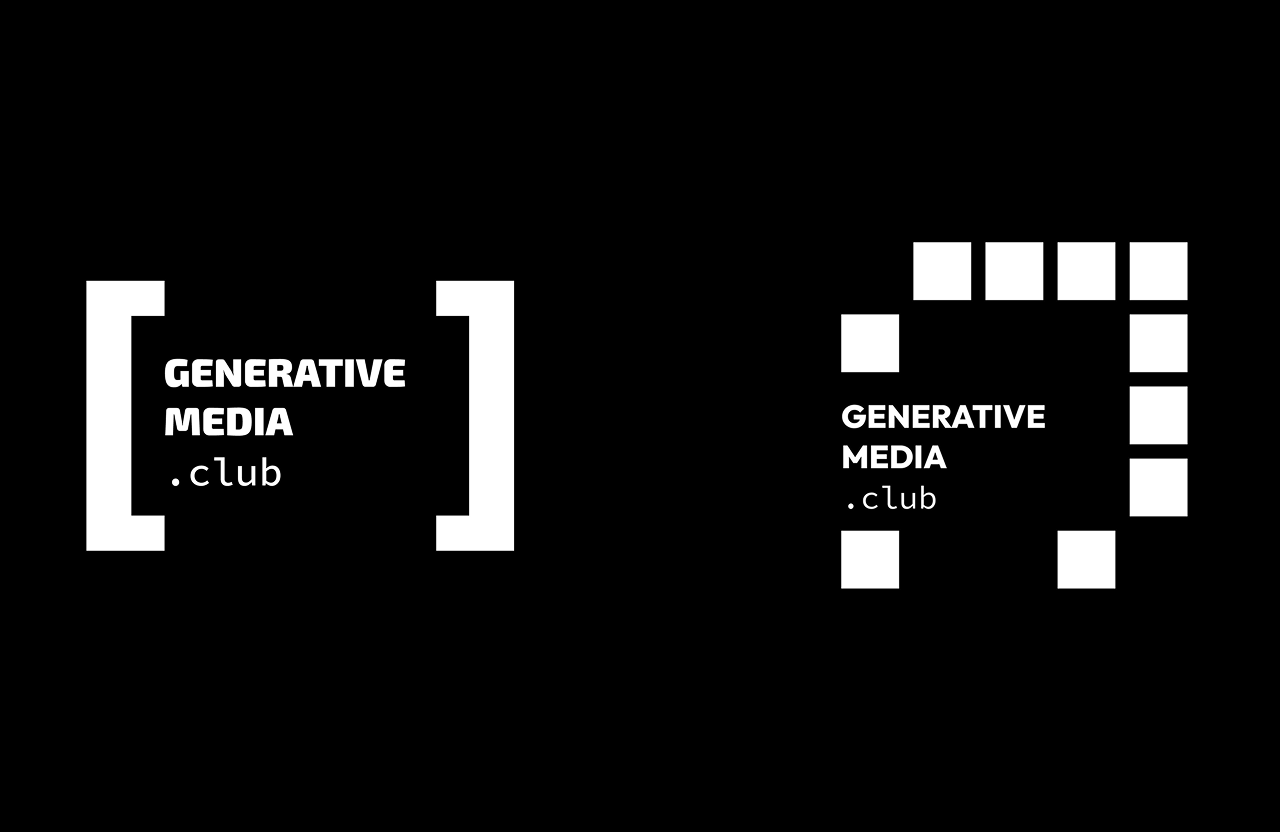
Take the logo. The old one wrapped our name in brackets, [ ]. A container. A static frame holding the brand still. The new one replaces those brackets with a lightweight spaceship: one of the small shapes the rules generate on their own, a pattern that doesn’t sit there, it travels across the grid. We didn’t redraw the logo. We swapped a frame that holds the brand for a pattern that runs it.

Before — a frame that holds it still

After — a pattern that runs it
Here’s where it stops being a metaphor and starts being the actual system. In our identity, how bright a cell looks depends on how long it has survived. A newborn cell is barely visible. A cell that’s lived through generation after generation glows at full strength. The brightest cells aren’t bright because of math. They’re bright because they lasted. We don’t light up the important cells. The cells that survive become the important ones.
That’s the thing noise could never give me. Meaning. A Perlin field is bright where the function says so. A GoL cell is bright because it earned it.
The system doesn’t show that life just one way. Sometimes it’s a single color deepening with age. Sometimes it’s all six brand colors at once, shuffled by the seed. Sometimes three tones the seed picks out. Different surfaces, different voices, same engine underneath.
Once the direction was locked, this is where Claude Code earned its keep: turning all of it into real grids, real mappings, real assets that export to every format we need. The vision was mine. The execution it multiplied, by weeks.
The logo isn’t a file anymore. The colors aren’t a palette. The brand identity isn’t a brandbook. It’s a living SDK: modular, reusable components the system assembles on the fly. An organism that runs the same rules every time and never hands back the same result twice.
05 What defines us is…
Game of Life is, literally, a game. No players, no winning, just simple rules and whatever emerges from them. The first time I watched it run, I understood something about GMC: we were never programmers on one side and artists on the other. We’re the people who stopped fighting that false split to play in the space between.
Someone once asked Louis Armstrong what jazz was. He said:
“What we play is life.” Louis Armstrong
Armstrong didn’t just play his instrument, he played with it, bending notes past where the sheet music ended, turning a horn into something nobody had heard before. That’s the difference between following the rules and playing inside them. Between a tool and a toy. Between code that runs and a brand that’s alive.
Same word. Both true.